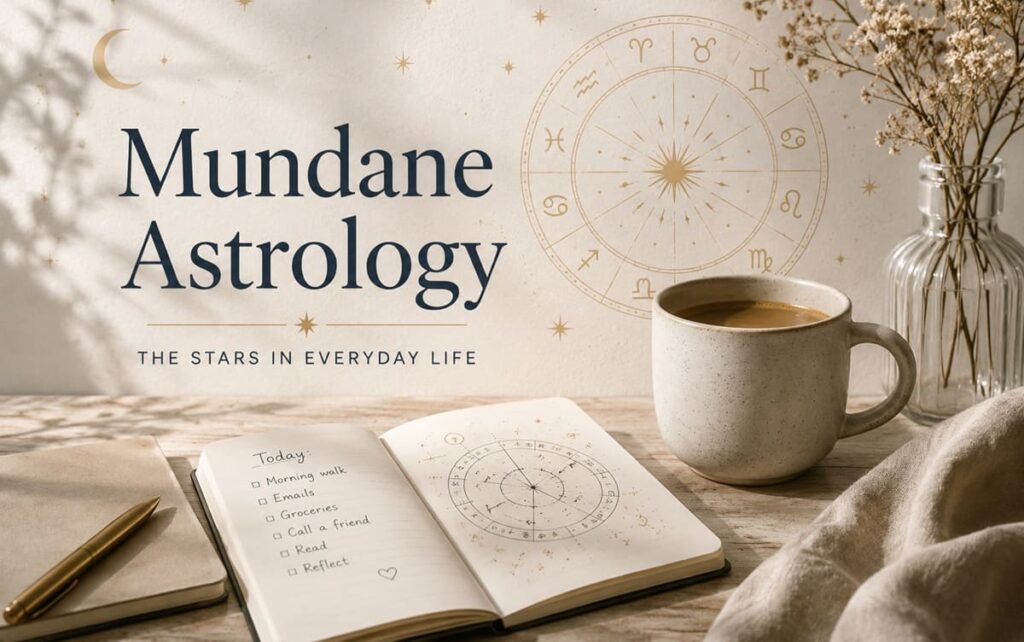
In a world obsessed with personal horoscopes and “what’s in the stars for me,” there exists a quieter, grander branch of astrology that looks beyond the individual. It peers at empires rising and falling, economies crashing or booming, wars igniting, and collective destinies unfolding. This is Mundane Astrology—the astrology of nations, leaders, global events, and the collective human story.
While natal astrology feels intimate, Mundane Astrology feels almost god-like in scale. It treats the Earth itself as the subject of the cosmic chart.
What Exactly Is Mundane Astrology?
Mundane Astrology (from the Latin mundus, meaning “world”) analyzes planetary movements, eclipses, ingresses, and cycles to forecast and interpret large-scale events. It examines:
- The fate of countries and their leaders
- Economic trends and financial markets
- Wars, peace treaties, and geopolitical shifts
- Natural disasters, weather patterns, and climate events
- Cultural movements, scientific breakthroughs, and social revolutions
Instead of focusing on your Sun sign, a mundane astrologer might study the Aries Ingress (when the Sun enters Aries each year) to create a “chart of the year” for an entire nation or the world. They look at national horoscopes (often set for the moment of independence or founding), planetary cycles like the Saturn-Jupiter conjunctions (which occur roughly every 20 years and mark shifts in economic and social paradigms), and major eclipse paths.
A Brief History: From Kings to Kingdoms
Mundane Astrology is actually older than personal horoscopes. Ancient Mesopotamian astrologers advised kings on the destiny of the realm. In India, Mundane Jyotisha has been practiced for millennia through texts like the Brihat Samhita by Varahamihira, which contains detailed chapters on omens, weather, and national affairs.
During the Renaissance in Europe, astrologers like William Lilly famously predicted the Great Fire of London using mundane techniques. In the 20th century, figures like Charles Harvey and others refined the field using modern data and statistical approaches.
Key Tools of the Mundane Astrologer
- Ingress Charts — The Sun’s entry into the cardinal signs (Aries, Cancer, Libra, Capricorn) creates powerful mundane charts.
- Eclipse Charts — Solar and lunar eclipses act as cosmic triggers, especially when they fall on sensitive points in a nation’s chart.
- Great Conjunctions — Jupiter-Saturn cycles are often called the “clock of history.” The 2020 conjunction in Aquarius, for instance, coincided with massive shifts toward technology, decentralization, and social upheaval.
- Planetary Cycles — Uranus-Pluto squares for revolutions, Neptune transits for ideological waves or scandals, Mars-Saturn for conflicts.
- National Horoscopes — Charts for the USA (July 4, 1776), India (August 15, 1947), or the European Union.
Real-World Examples That Still Astonish
- The 2008 financial crisis aligned with significant Saturn-Uranus oppositions and Pluto’s entry into Capricorn (sign of institutions and financial structures).
- The COVID-19 pandemic emerged during a rare Saturn-Pluto conjunction in Capricorn (2020), a combination historically linked to hardship, restriction, and systemic transformation.
- Major wars often ignite under Mars activations or when malefic planets afflict national Sun/Moon positions.
These aren’t always perfect predictions, but the correlations continue to intrigue researchers who approach the subject with intellectual honesty.
Mundane Astrology in the Age of Data
Critics call it pseudoscience. Practitioners argue it’s a symbolic language for understanding complex systems—much like how economists use models that also fail sometimes but still provide value.
Today’s mundane astrologers blend traditional techniques with data analytics. They track:
- Stock market cycles against planetary returns
- Climate patterns against outer planet transits
- Social media trends and collective mood shifts against Moon/Neptune influences
Why It Matters More Than Ever
We live in an interconnected world. A single policy decision in Beijing can affect farmers in Brazil. A viral tweet can shift elections. Mundane Astrology offers a lens that says: There are larger rhythms at play.
It doesn’t remove human agency—leaders still make choices, people still act—but it suggests we operate within cosmic weather patterns. Understanding the weather doesn’t mean you can’t build a strong house; it just helps you prepare.
Final Thoughts: The Cosmic Citizen
Studying Mundane Astrology cultivates a deeper sense of being a “cosmic citizen.” You begin to see protests, breakthroughs, scandals, and golden ages not as random chaos, but as movements in a vast, breathing symphony.
The stars don’t dictate every headline. But they may whisper the mood of the times—and the wise listen.
What mundane event are you curious about? Drop a country, year, or current global situation in the comments, and I may explore its astrological weather in a future post.